

TTM Test
Personal Data Protection Notice (KVKK)
Personal Data Protection Notice (KVKK)
TTM Test Teknolojileri Merkezi (TTM TEST) processes personal data in accordance with Turkish Personal Data Protection Law No. 6698 (KVKK), taking care to process data lawfully, fairly, for specified and legitimate purposes, and in a manner that is relevant, limited and proportionate to those purposes.
1. Data Controller
For website, contact and quotation processes, the data controller is TTM TEST. Contact: Burhaniye, 4. Ara Sk. 34676 Üsküdar/İstanbul, Türkiye; telephone +90 216 318 18 00; e-mail iletisim@ttmtest.com.tr.
2. Personal Data That May Be Processed
- Identity and contact data: name, surname, telephone, e-mail and company information,
- Request/project data: message content, requested service, project details and files voluntarily submitted by the user,
- Transaction-security/technical data: IP address, date/time, session, browser/device and security logs,
- Technical data generated through cookies or similar technologies where required for the relevant website function.
3. Purposes of Processing
- Receiving and responding to contact, information and quotation requests,
- Conducting preliminary assessment and quotation processes for requested services,
- Managing contractual and operational processes where a customer, supplier or business relationship is established,
- Protecting website and information-system security and preventing abuse,
- Complying with legal obligations and establishing, exercising or protecting legal rights,
- Managing service-quality, business-continuity and corporate communication processes.
4. Legal Grounds
Depending on the processing activity, personal data may be processed on the legal grounds set out in Article 5 of the KVKK, including where processing is directly related to the establishment or performance of a contract, necessary for compliance with a legal obligation, necessary for the establishment, exercise or protection of a right, or necessary for the legitimate interests of the data controller provided that the fundamental rights and freedoms of the data subject are not harmed. Where explicit consent is legally required, it is obtained separately and on the basis of a freely given choice.
5. Collection Methods
Personal data may be obtained through website forms, e-mail, telephone, user-uploaded files, face-to-face or corporate communication channels, and technical/security records generated during website use, by automatic or partially automatic means.
6. Transfers
Personal data may be transferred, to the extent required for the relevant purpose, to authorized public authorities, legal/financial advisers, hosting-IT-communications service providers and other authorized recipients in accordance with Article 8 of the KVKK. If a transfer outside Türkiye occurs through third-party technologies, Article 9 of the KVKK and applicable transfer rules are applied.
7. Retention
Personal data is retained for the period required by the processing purpose and applicable statutory retention periods. When the legal grounds for processing cease to apply, data is deleted, destroyed or anonymized in accordance with applicable rules and TTM TEST retention/disposal processes.
8. Your Rights Under Article 11 of the KVKK
As a data subject, you may apply to TTM TEST to:
- learn whether your personal data is being processed,
- request information if it has been processed,
- learn the purpose of processing and whether it is used in accordance with that purpose,
- learn the third parties to whom it is transferred in Türkiye or abroad,
- request correction of incomplete or inaccurate data,
- request deletion or destruction where the conditions under the KVKK are met,
- request notification of correction/deletion/destruction to third parties to whom data has been transferred,
- object to a result arising against you exclusively through automated analysis,
- claim compensation if you suffer damage due to unlawful processing.
9. How to Apply
Requests concerning your KVKK rights may be submitted to TTM TEST in accordance with the Communiqué on the Procedures and Principles of Application to the Data Controller. Your application should clearly identify you and your request and may be sent to Burhaniye, 4. Ara Sk. 34676 Üsküdar/İstanbul, Türkiye, or through an appropriate electronic communication channel. Additional verification information may be requested depending on the application.
10. Security and Updates
TTM TEST applies reasonable administrative and technical measures to prevent unlawful processing/access and to safeguard personal data. This notice may be updated when processing activities or applicable rules change.
CPT (Cone Penetration Test)
Cone Penetration Testing (CPT) is a high-resolution in-situ geotechnical test in which an instrumented cone is pushed into the ground at a controlled rate while penetration resistance is recorded continuously.

Seismic CPT (SCPT) – Seismic Cone Penetration Test
Seismic CPT (SCPT) combines CPT/CPTu penetration measurements with seismic wave-velocity data to characterize both static and dynamic ground response.
Flat Dilatometer Test (DMT)
Flat Dilatometer Testing (DMT) is an in-situ test used to assess stress and deformation behaviour by expanding a flexible membrane mounted on a flat blade pushed into the soil.
Seismic Dilatometer Test (SDMT)
Seismic Dilatometer Testing (SDMT) combines DMT membrane measurements with shear-wave velocity (Vs) data to assess static and dynamic soil behaviour in one investigation.
Standard Penetration Test (SPT)
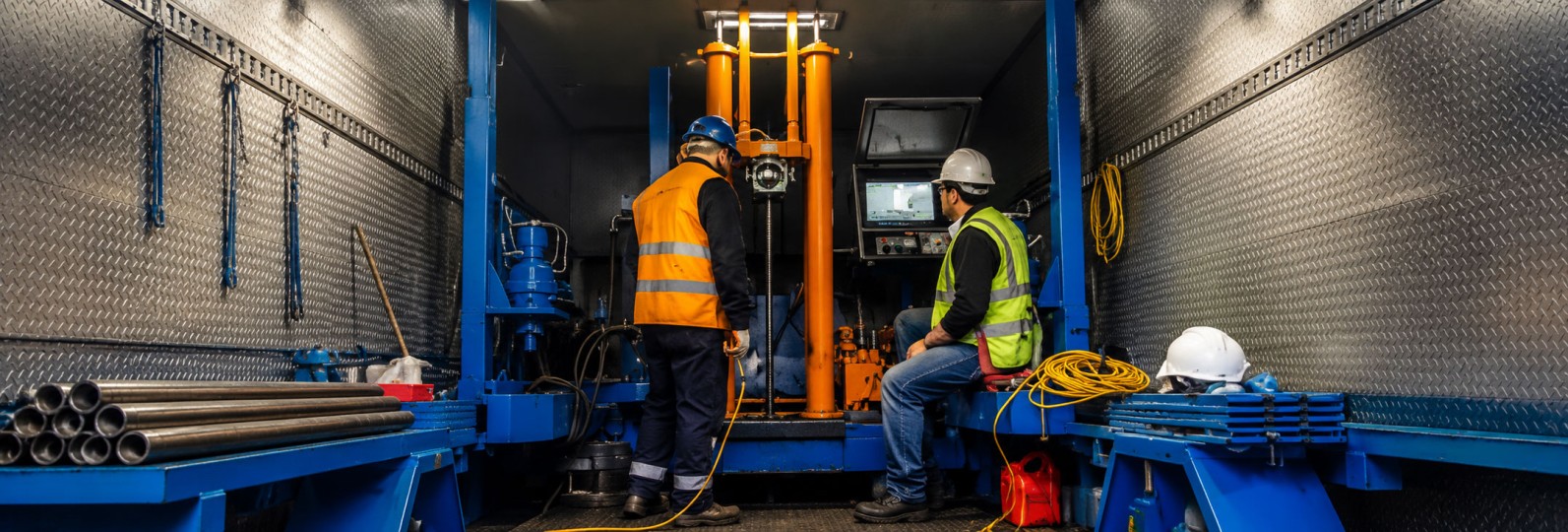
The Standard Penetration Test (SPT) is a borehole-based dynamic in-situ test used to obtain penetration resistance and representative samples at selected depths.
Pressuremeter Test
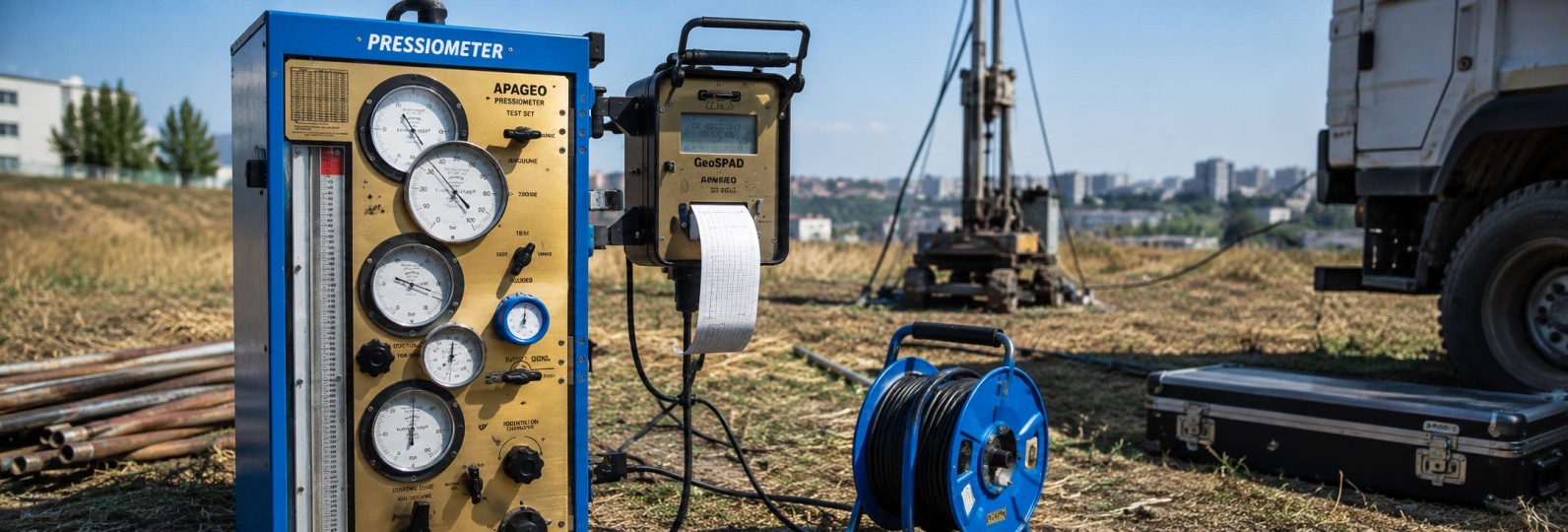
Pressuremeter testing evaluates the pressure-deformation response of the ground in a borehole and supports assessment of in-situ stiffness and strength behaviour.
In-Situ Permeability Tests
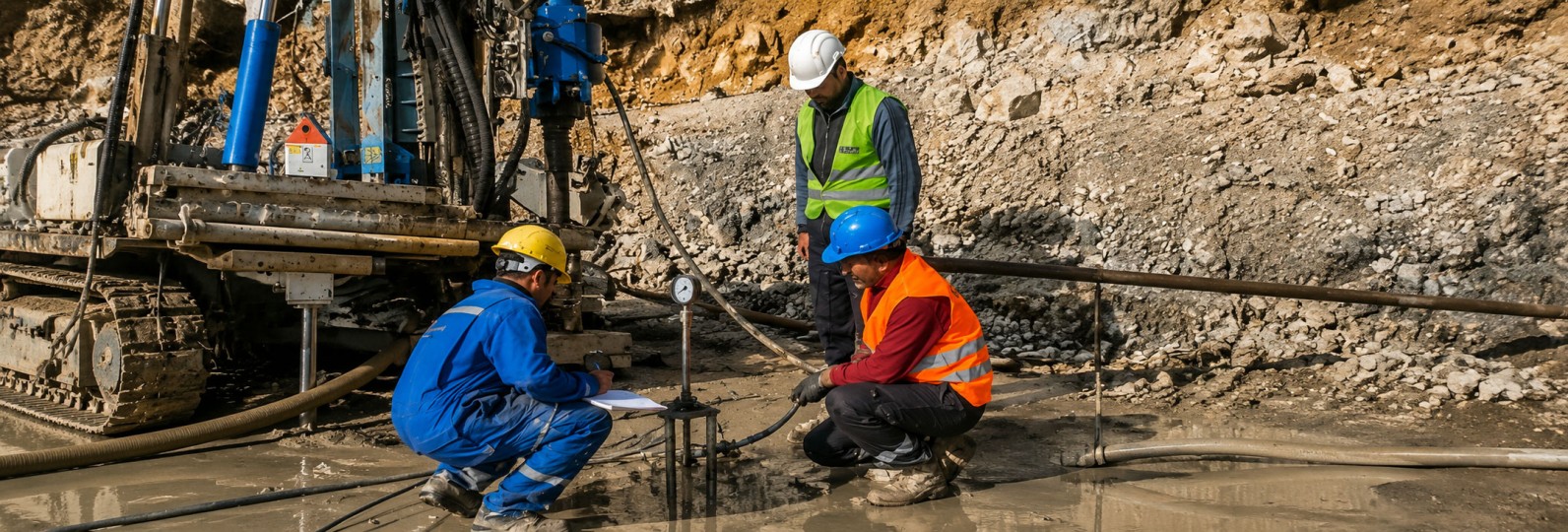
In-situ permeability testing evaluates the hydraulic behaviour of soil or rock and supports seepage, drainage and groundwater-related engineering decisions.

Why TTM TEST?
Why TTM TEST?
Since 1994, TTM TEST has supported projects with geotechnical drilling, in-situ testing, CPT/SCPT/DMT/SDMT, geophysics, instrumentation, laboratory testing and engineering services. Experienced technical teams, modern equipment and disciplined reporting provide reliable data for engineering decisions.
Selected geotechnical investigation, drilling, in-situ testing and engineering projects delivered by TTM TEST.
TTM TEST supports projects with integrated site investigation, geotechnical drilling, in-situ testing, laboratory and engineering services.
Frequently Asked Questions
CPT is an in-situ geotechnical test in which an instrumented cone is pushed into the ground at a controlled rate while cone resistance and sleeve friction are recorded continuously. CPTu also measures pore-water pressure.
CPT is widely used in clay, silt and sand, particularly soft fine-grained and loose granular soils. Gravel, cobbles, boulders or very hard layers may restrict penetration and should be considered during planning.
Standard CPT measures cone tip resistance and sleeve friction. CPTu adds pore-water pressure measurement, providing additional information for interpreting saturated fine-grained soils and layer transitions.
SCPT combines CPT/CPTu penetration measurements with seismic measurements so that soil stratigraphy and shear-wave velocity (Vs) can be evaluated within the same investigation programme.
SCPT can provide cone resistance, sleeve friction, pore-pressure data where CPTu is used, and a depth-dependent shear-wave velocity (Vs) profile.
DMT is an in-situ test in which a flexible membrane on a flat blade is expanded under controlled pressure to assess soil stress and deformation behaviour.
SDMT combines conventional DMT measurements with seismic Vs measurements, allowing static deformation/stress indicators and dynamic soil properties to be evaluated in the same profile.
Yes. CPT is commonly carried out on land and can also be performed in marine or coastal environments when suitable platforms, reaction systems, access and equipment are provided.
No. SPT is a dynamic test performed in a borehole at discrete intervals, while CPT is a static push test that provides continuous profiling. The methods may be used together depending on project objectives.
Project location, required test type, approximate number and target depth of tests, available ground information, site access, working level and reporting requirements help define an efficient field programme and quotation.
Professional Engineering Solutions for Your Project
- Experienced Technical Team
- Prompt Project Review
- Nationwide Field Capability
- Reliable Testing and Reporting